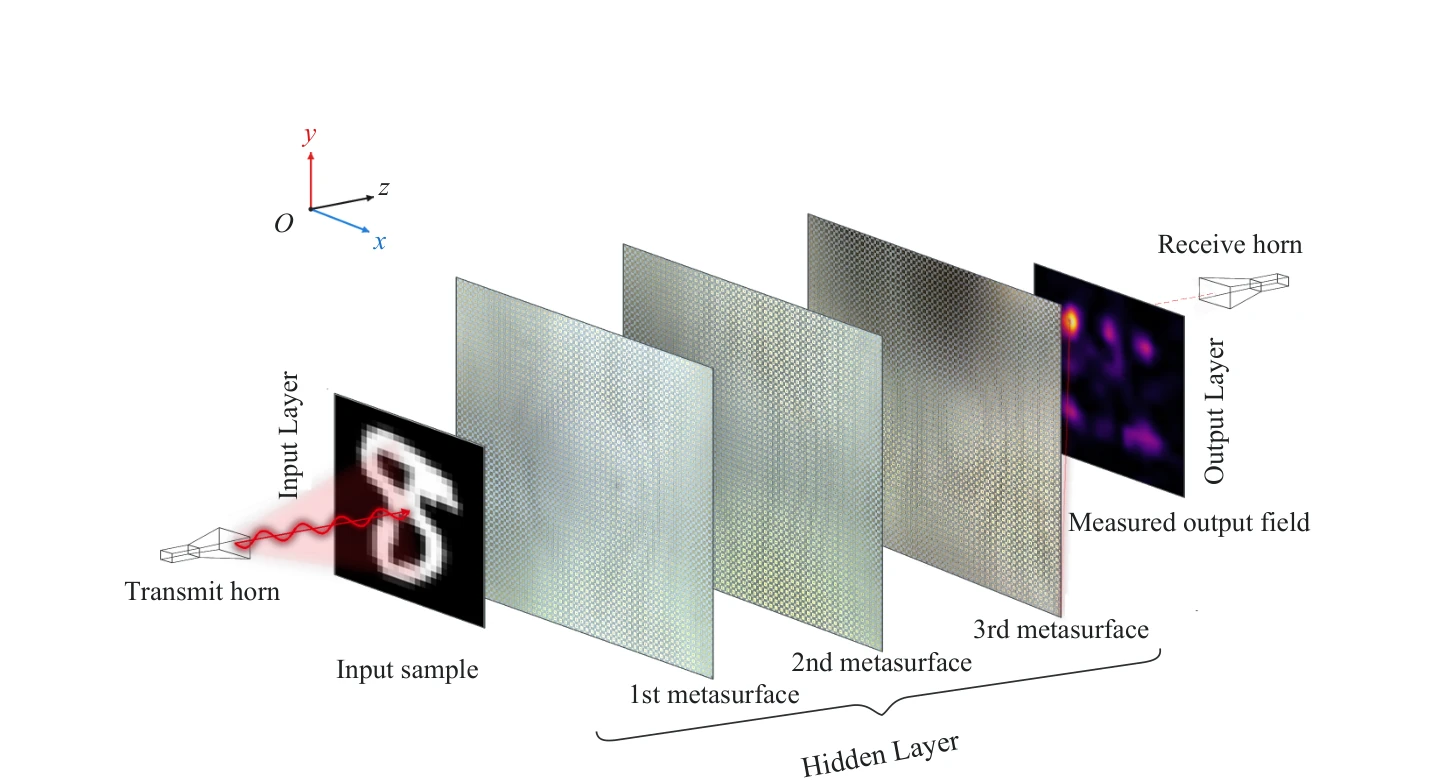
Wave-based inference
Cascaded phase layers transform an incoming wavefront through propagation, interference, and diffraction to focus energy into class-specific output regions.
D2NN · free-space inference · passive computing
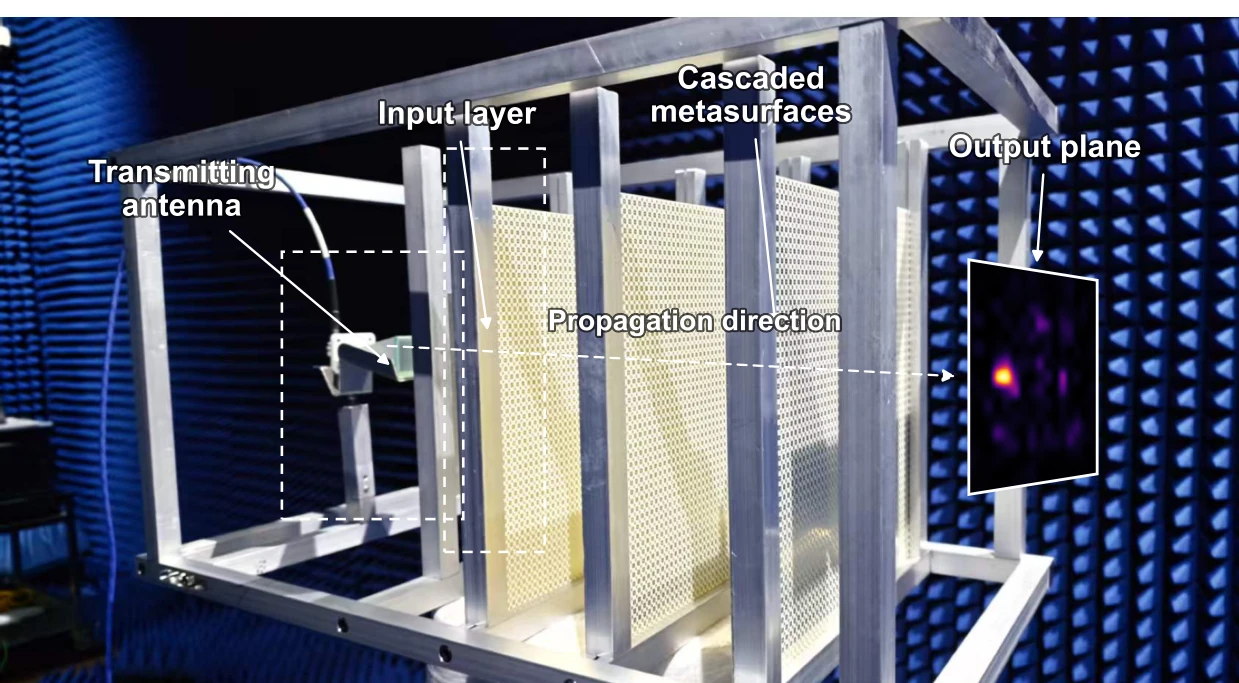
Metasurfaces · wave computing · inverse design
Designing passive electromagnetic systems that compute through waves.
Researcher at the College of Electronics Science and Technology, National University of Defense Technology. I study how frequency, polarization, and engineered phase surfaces can turn a shared aperture into a programmable inference engine.
Now Accepted for publication in Optics Express, now in production.
Accuracy values refer to different evaluation sets and should not be read as a single benchmark.
01 / Research
My research connects electromagnetic design with learning systems: engineering passive structures that shape a wavefront, select a task, and produce a decision without active digital processing in the inference path.
Cascaded phase layers transform an incoming wavefront through propagation, interference, and diffraction to focus energy into class-specific output regions.
D2NN · free-space inference · passive computing
Frequency and polarization become independent computational axes, allowing multiple tasks to share the same physical volume instead of requiring separate devices.
20/30 GHz · X/Y polarization · four channels
Quantization-aware training maps continuous phase fields onto a discrete 4-bit M-FSS codebook, keeping the learned response close to the structure that can actually be built and measured.
4-bit phase · M-FSS unit cells · measurement-aware
02 / Featured work
Accepted · in production · Optics Express · 2026
A fixed passive aperture becomes a four-channel classifier by combining two microwave frequencies with two orthogonal linear polarizations.
Diffractive deep neural networks perform inference through wave propagation, but microwave implementations often provide limited channel capacity per aperture. This work demonstrates a passive dual-frequency, dual-polarization D2NN using three cascaded multilayer frequency-selective-surface layers. Joint multiplexing of 20 and 30 GHz waves with X and Y polarizations creates four selectable physical channels covering 36 EMNIST classes. A center-grid/vertex-grid mapping aligns the phase distributions with the interleaved unit-cell geometry, while 4-bit quantization-aware training maps the learned phases to a fabrication-compatible codebook.
03 / Publications
A record of current and forthcoming research in wave computing, metasurface design, and applied electromagnetics.
Four selectable nine-class inference channels in one passive microwave aperture, enabled by joint frequency–polarization multiplexing and a fabrication-compatible phase codebook.
This page will be updated when the article is published online. For a copy of the accepted manuscript, please get in touch.
04 / About
Tao Zeng is a researcher at the College of Electronics Science and Technology, National University of Defense Technology. Tao's work focuses on the design, fabrication, and experimental validation of microwave and millimeter-wave metasurfaces for wave-based computing.
The current research program asks a practical question: how much computation can be embedded into a passive electromagnetic structure before active electronics become necessary? The four-channel D2NN study is one answer—combining frequency, polarization, and learned phase distributions in a single shared aperture.
@article{zeng2026frequency,
author = {Zeng, Tao},
title = {Orthogonal Frequency-Polarization Multiplexing in a Four-Channel Cascaded-Metasurface Diffractive Neural Network},
journal = {Optics Express},
year = {2026},
note = {Accepted for publication; in production}
}